Welcome to

The Association for Educational Assessment – Europe

The foremost association for assessment professionals throughout Europe.

What We Offer

AEA-Europe offers its members a range of opportunities to network with each other, sharing news, debate and research. At institution level, the association provides a forum for international liaison and co-operation.
woman represents facebook

Accreditation

Become an AEA-Europe Fellow, Practitioner or Associate.
man represents twitter

SIG Membership

Join one of AEA-E’s Special Interest Groups.
woman checking calendar

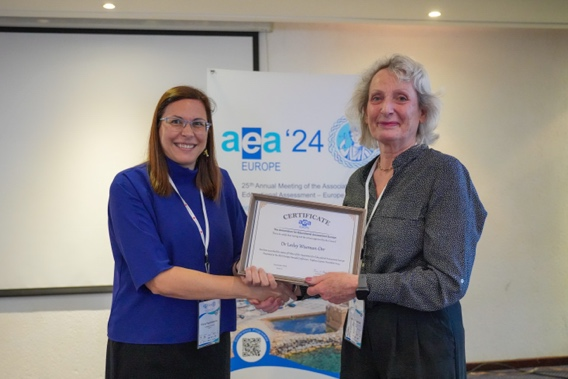
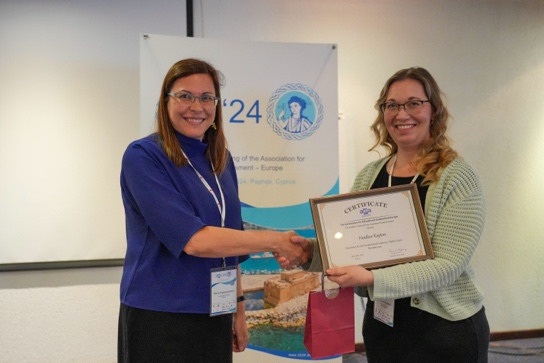
Awards

Get recognition for your work and research.

27th Annual Conference

Rome, Italy

25-28 November, 2026

AEA Europe 2026

News

Keep in touch with what’s happening.

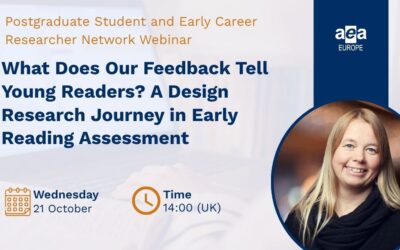
New Webinar

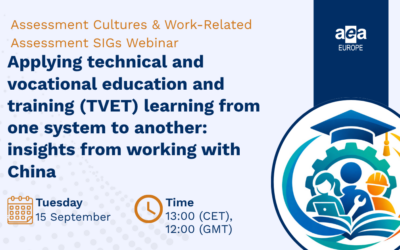
New Webinar

When fairness and comparability collide: Teachers’ perceptions of accommodations and bias in inclusive assessment

read more

Calendar of Events

Stay up to date with upcoming events and key dates.

16th April 2026
  • Hollisitc Assessment SIG Webinar - April 16, 2026

    16th April 2026  12:00 pm - 1:00 pm

    Title: Building holistic systems for educational improvement: From curriculum to pedagogy to assessment principles.

    A special webinar dedicated to discussing the HASIG Position Paper and the future direction of the SIG.

27th April 2026
  • Assessment Cultures SIG - Andrew Watts webinar

    27th April 2026  12:00 pm - 1:00 pm

    Andrew Watts

    Webinar April 27 2026

    CET (13-14) and GMT (12-13)


    Revisiting the thought in our first webinar
     
    AEA-Europe’s Assessment Cultures SIG was formed a year after the publication of the book Assessment Cultures: Historical Perspectives edited by Professor Martin Lawn and Dr. Cristina Alarcon (pub. Peter Lang, Studia Educationis Historica, 2018).  Cristina was the first person to present a webinar for us, Assessment Cultures: Challenges and Chances of an analytical tool, on 14th May 2021.
     
    Cristina’s talk helped us to address the questions Why should we make ourselves more aware of our assessment cultures? And how may we do that? This is a significant time for us to look back: the fourth of our colleagues has now taken over as Chair of the SIG and we might ask ourselves how we judge our progress. 
     
    Cristina proposed that the concept of ‘assessment culture’ could be used to evaluate proposals that countries might take part in international assessments. She had personal experience of two assessment cultures as a student, in Germany and Chile.
     
    The eighth slide in Cristina’s talk raises the question,  Why ‘within the current homogenizing global testing regime’ must we avoid neglecting ‘the cultural and historical conditions of assessment’? Cristina advocates a diversity of assessment practices. She favours the preservation of ‘a qualitative-contextualising constructivism’, as opposed to a ‘testing culture’ whose reference is ‘behaviourism and the psychometric-quantitative paradigm’. 
     
    Bildung is an important concept which has been influential throughout Europe. Its emphasis is on the humanising intentions of education and thus it compares with a more scientifically, quantitative approach. 
     
    Cristina quotes the following definition:
    Bildung means the stimulation of all the powers of a human being so that these develop harmoniously … [and] lead to a self-determining individuality … which enriches humanity in its ideality and uniqueness".
                          (Brockhaus Encyclopaedia, Volume 2, 20th edition 1997, s.v."Bildung")
     
    Cristina’s definition of the term assessment culture
     
    An assessment culture is a historically grounded ensemble and arrangement of 
                Mental representations
                Beliefs
                Interpretation patterns
                Patterns of behaviour
    whose purpose is to make educational meaning within a particular context of time and space.  
     
    Cristina develops this with a description of the “Dimensions of an Assessment Culture” in which she identifies ten elements which may be found. Later she describes these dimensions as ‘Assessment instruments’):

    • Practices / rituals
    • Ideals
    • Theories
    • Norms
    • Cognitive processes
    • Knowledge
    • Traditions
    • Actors
    • Instruments
    • Artefacts

Our Blog

Join the conversation and contribute to our blog

What I Learned from My PhD Journey

As I sit here now, waiting for the evaluation committee to review my PhD dissertation, I finally have the time to reflect on the journey I began five years ago.

read more

Should we trust teachers’ practices or standardized tests?

While students around the world received last summer their report cards and diplomas, in Switzerland, the Federation of Swiss Enterprises (Economiesuisse[1]) recently took a stand on the issue of grades, in a policy paper entitled “Debate on grades at school: we’ve lost our way…”.

read more